Finish what was signed
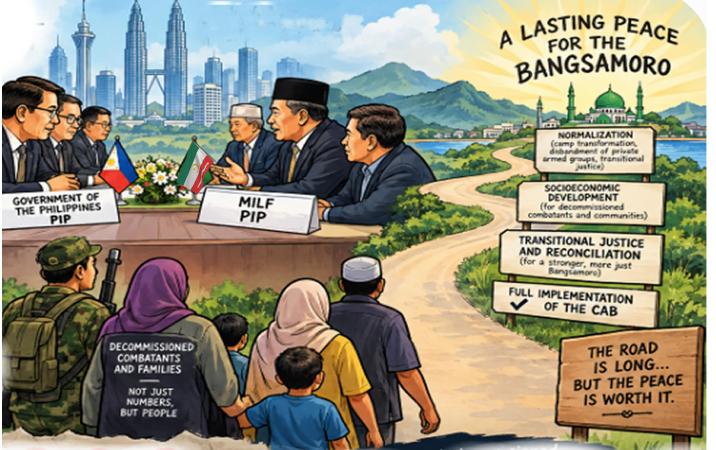
The Special Meeting of the Government of the Philippines and Moro Islamic Liberation Front Peace Implementing Panels (PIP) in Kuala Lumpur, Malaysia on September 25 was not a ceremony. It was a reminder, issued eleven days after the first Bangsamoro parliamentary elections, that an election is a milestone of the Comprehensive Agreement on the Bangsamoro (CAB), not its conclusion.
MILF PIP Chair Mohagher Iqbal put the point plainly at the Grand Hyatt table: the Parties did not meet to reopen what they had settled. They met to resume and complete the work they signed up for. That distinction matters. The political track has advanced. The regular Bangsamoro Parliament will assume office on October 30, when the transition period ends. Normalization, camp transformation, the disbandment of private armed groups, and transitional justice have not kept the same pace. A parliament seated on an unfinished agreement is not the peace the Bangsamoro were promised in 2014.
The meeting produced work, not only language. The Panels approved the terms of reference of the Technical Working Group on Roadmap Development for the implementation of the CAB. They renewed the Ad Hoc Joint Action Group until September 25, 2027 and the Civilian Protection Component until September 25, 2028. They agreed in principle on a framework for the management of small arms and light weapons, and directed the technical working group to finish it with the disbandment of private armed groups and the decommissioning of combatants in view. They signed an addendum on the socioeconomic program for decommissioned combatants and the six previously acknowledged camps, shifting delivery toward an integrated, beneficiary-centered mode. They adopted Resolution No. 3, series of 2026, of the technical working group on transitional justice and reconciliation, aimed at strengthening bills in the 20th Congress for a National Transitional Justice and Reconciliation Commission for the Bangsamoro.
These are the right instruments. They will mean little if they stay on paper. Decommissioned combatants and the families who waited with them have already given the process its most concrete proof of good faith. Socioeconomic support that arrives years late is not normalization. Camp transformation that remains a plan is not transformation. Private armed groups that continue to operate beside a decommissioning process undermine both security and the moral basis of laying down arms. As the MILF Panel has said, these are not MILF demands. They are common obligations under the CAB.
The election of September 14 deserves recognition. It was a commitment kept. It also exposed irregularities and violence that must be investigated and prosecuted without regard to affiliation. The political and peace tracks remain joined. Whoever the parliament elects as chief minister will be more than the chief executive of the BARMM. That office can also serve as interlocutor between the peace mechanisms and the MILF, so that governance and the remaining work of the CAB move together rather than on separate clocks. The new Parliament cannot be asked to carry a process whose normalization side is still incomplete, nor can normalization be postponed because politics has become more crowded.
Malaysia’s role remains indispensable. The Malaysian government has stayed with this process since 2001, through progress and through stalls. Facilitator Tan Sri Zulkifli Zainal Abidin kept showing up on September 25. Peace processes are sustained by those who keep showing up. The International Contact Group, the Third Party Monitoring Team, and the other mechanisms have the same duty now: to measure delivery, not attendance.
An Exit Agreement will come when the commitments are fulfilled, not when a calendar looks tidy. There is no virtue in declaring the process finished while combatants still wait, camps remain untransformed, private armed groups persist, and transitional justice is still a bill. The Kuala Lumpur meeting was a start. Its measure will be what the Parties do after it.
The road ahead is still long. The Bangsamoro have walked harder roads. What they ask now is simpler, and harder: that both Parties finish what they signed, faithfully and in full, so that the peace chosen in 2014 is the peace lived after October 30.