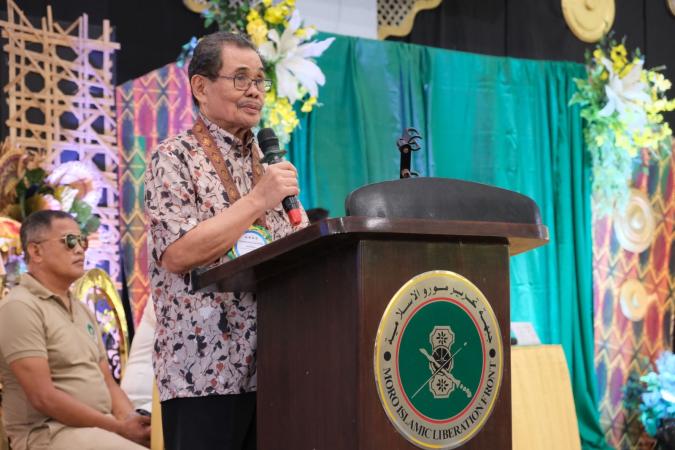
GPH, MILF fast-track bill creating national transitional justice body for Bangsamoro
COTABATO CITY — The Government of the Philippines (GPH) and the Moro Islamic Liberation Front (MILF) have stepped up efforts to secure passage of a law creating the National Transitional Justice and Reconciliation Commission for the Bangsamoro (NTJRCB), one of the remaining major commitments under the Comprehensive Agreement on the Bangsamoro (CAB).
The joint GPH-MILF Technical Working Group on Transitional Justice and Reconciliation (TWG-TJR) this week presented an enhanced version of the NTJRCB bill to legislative staff of the House of Representatives Special Committee on Peace, Reconciliation and Unity, as well as to civil society organizations and transitional justice experts, the GPH-MILF Joint Communications Committee said in a statement on Friday, Oct. 23.
The commission would oversee a program addressing the harm suffered by the Bangsamoro people during decades of armed conflict, including human rights violations and land dispossession. It would acknowledge what victims went through, provide remedies and help communities recover.
Peace process not yet complete
MILF Peace Implementing Panel Chair Mohagher Iqbal stressed that transitional justice is among the commitments both parties must fulfill. He spoke at the close of the GPH-MILF Peace Implementing Panels’ special meeting in Kuala Lumpur on Sept. 25, where the panels approved the proposed enhancements.
“The Bangsamoro Government and the first parliamentary elections are major achievements. They do not mean that the peace process is complete,” Iqbal said.
“Decommissioning must be concluded. The camps must be transformed. Private armed groups must be dismantled. Transitional justice must be delivered. As a signatory to the Comprehensive Agreement on the Bangsamoro, the MILF continues to carry responsibility for seeing these through, and we expect the same of our partners,” he added.
Presidential Peace Adviser and GPH Peace Implementing Panel Chair Secretary Mel Senen Sarmiento said the briefings showed that the legislative process is “on track and is moving forward at a faster pace.” He said the government would keep working with the MILF and both chambers of Congress to establish the commission.
‘Heart and soul’ of the peace process
The TWG-TJR briefed House legislative staff and other concerned congressional committees on Oct. 19. It held a consultation workshop with civil society groups and experts the following day to refine the bill further.
MILF TWG-TJR Chair Ammier Dodo said transitional justice aims to help communities confront what happened in the past and heal from it.
“This is the ultimate face of the peace process. It is considered the heart and soul of the peace process,” Dodo said.
GPH TWG-TJR Chair Cesar D. De Mesa, executive director of the Office of the Presidential Adviser on Peace, Reconciliation and Unity (OPAPRU), said the commission should not reopen old wounds but should advance healing and reconciliation.
Building on four bills
The enhanced version consolidates four measures filed in the 20th Congress: House Bill 935 by the Akbayan Party-list, and Senate Bills 570, 532 and 854, filed by Senators Risa Hontiveros, Loren Legarda and Jinggoy Ejercito Estrada.
Among its key changes are stronger guiding principles, a clearer definition of transitional justice in line with the CAB, a defined role for civil society, clarified links with the Bangsamoro Transitional Justice and Reconciliation Commission, and a refined mandate and set of functions for the national body.
Lawyer Anna Tarhata Basman led the drafting, based on stakeholder roundtables, expert interviews and vetting sessions with the TWG-TJR.
The working group finalized the enhancements on Aug. 7 and endorsed them to the Peace Implementing Panels through TWG-TJR Resolution No. 3.
The TWG-TJR will consolidate the inputs from the briefings and consultations and work with legislative staff to harmonize the bills before endorsing them to the concerned congressional committees.