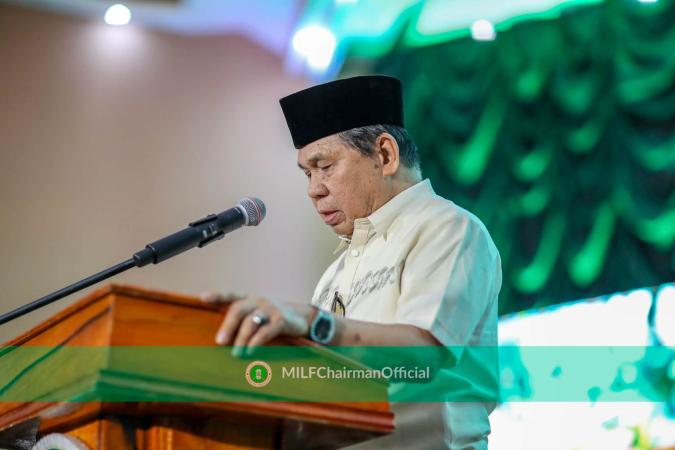
Murad leads 25 UBJP MPs in oath-taking, says power must serve the deprived
COTABATO CITY — Twenty-five newly elected Members of Parliament (MPs) from the United Bangsamoro Justice Party (UBJP) were sworn in at the Shariff Kabunsuan Cultural Complex on Wednesday, Oct. 21. Moro Islamic Liberation Front (MILF) Chair and UBJP President Ahod "Al Haj Murad" Ebrahim reminded them that public office is a trust to be fulfilled, not a privilege to be enjoyed.
"In Islam, leadership is not a privilege to be enjoyed. It is a responsibility to be fulfilled," Ebrahim told party members and leaders.
"Public office is not an opportunity to serve ourselves, our families, or our personal interests. It is an opportunity to serve the people, especially those who have long been deprived of justice, opportunity, and dignity," he said.
Who took the oath
Ebrahim led the party-list nominees, who included Datucan "Mohagher Iqbal" Abas, Ali Solaiman, Eduard Guerra, Ibrahim Ali, Said Salendab, Mohammad Yacob, Amir Balindong, Atty. John Anthony Lim, Haber Asarul, Atty. Sha Elijah Dumama-Alba, Nordjianal Dipatuan-Ducol, Atty. Raissa Jajurie, Said Shiek and Ali Salik.
The district representatives present were Paisal Sali (Basilan District 2), Atty. Sheriff Abas (Cotabato City District 1), Mansor Ebrahim (Special Geographic Area District 1) and Elaysa Latiban (Special Geographic Area District 2).
The sectoral representatives sworn in were Engr. Aida Silongan (women), Atty. Mary Ann Arnado and Yul Adelfo Olaya (settlers), Sulffy Abbas (youth), Marjanie Macasalong (traditional leaders) and Muhammad Nadzir Ebil (ulama).
UBJP Secretary-General and Spokesperson Engr. Mohajirin Ali said the other elected MPs could not attend for various reasons, including health concerns and oaths they had already taken in their localities.
‘Not the end of our struggle’
Ebrahim traced the Bangsamoro’s political transformation to generations of sacrifice in defense of homeland, faith and identity. He paid tribute to the martyrs, ulama, civil society organizations, women, youth and ordinary people who bore the burdens of the struggle.
He called the creation of the Bangsamoro Autonomous Region in Muslim Mindanao (BARMM) and its Parliament monumental milestones, but said these mark only a starting point.
"The attainment of political autonomy is not the end of our struggle. It is the beginning of a greater responsibility," Ebrahim said.
"The true challenge today is not just preserving the power granted to us, but turning the gains of the peace process into tangible improvements in everyday lives," he added.
Race to 41
Under the parliamentary system set by the Bangsamoro Organic Law, BARMM’s Chief Minister is not elected directly by voters but by the 80 MPs, who serve as an electoral college. A candidate needs the support of a majority, or at least 41 members.
With no party winning a majority in the Sept. 14 elections, parties, district representatives and sectoral blocs have been negotiating intensely to reach that threshold.
Asked about a rival bloc’s claim that it already has 46 members to form the regional government, Mohajirin Ali said the outcome remains open.
"Anyone can release projections for numbers, and until D-Day arrives for the election of the Speaker and the Chief Minister, everything is still possible," he said.
Ali said he expects a formal coalition of parties rather than a traditional "rainbow coalition." Because no party secured a majority, he said, a stable government will need a partnership of at least two major political forces.
The first regular Bangsamoro Parliament convenes on Oct. 30 to elect its Speaker and the Chief Minister.