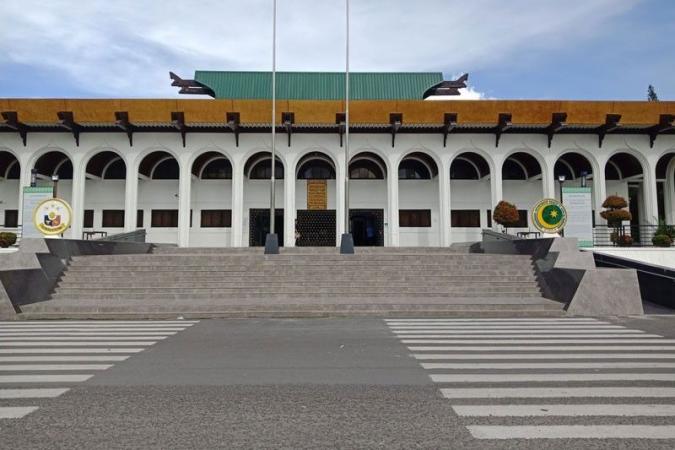
BTA bows out after 7 years of building the Bangsamoro government
COTABATO CITY — The Bangsamoro Transition Authority (BTA) closed its legislative chapter on Wednesday, Oct. 21. In its final plenary session, the interim Parliament born of the Moro struggle and the peace agreement between the Government of the Philippines and the Moro Islamic Liberation Front (MILF) handed the work of lawmaking to the region’s first elected legislature.
In seven years, the BTA built the institutions of the Bangsamoro Autonomous Region in Muslim Mindanao (BARMM) from the ground up, enacted 94 laws and laid the legal foundation for the region’s first parliamentary elections. Its successor, the 80-member Bangsamoro Parliament, assumes office on Oct. 30.
Six of seven priority codes
The Bangsamoro Organic Law (BOL) required the BTA to pass seven priority codes. Since March 2019 it has enacted six: the Administrative Code, Civil Service Code, Education Code, Electoral Code, Local Governance Code and the Indigenous Peoples’ Rights Act. Only the Bangsamoro Revenue Code is still pending.
Other landmark measures include the Bangsamoro Labor Code and the Budget System Act. The BTA also passed laws creating eight municipalities in the Special Geographic Area (SGA), formed from the 63 barangays in North Cotabato that voted to join BARMM in the 2019 plebiscite.
Each year from 2020 to 2026, the Parliament passed the regional budget that funded the Bangsamoro Government, its ministries, and programs in education, health, infrastructure, agriculture and social services.
Hospitals for underserved communities
Health care received particular attention. Sixteen laws established or upgraded hospitals across the region: six in Maguindanao del Sur, four in Lanao del Sur, and two each in Basilan, Tawi-Tawi and Sulu.
Among them were the upgrading of the Bangsamoro Regional Hospital and Medical Center to Level III, the expansion of bed capacities, and the creation of new general hospitals in communities long deprived of medical services.
The BTA also enacted the Bangsamoro Science High School System Act, the Bangsamoro Kulliyyah for Islamic Studies Act, the Bangsamoro Agriculture and Fisheries Training Institute Act, the Internally Displaced Persons Protection Act, the Bereavement Leave Act for BARMM Employees, and the Salamat Excellence Award for Leadership Act.
Born of the peace agreement
The BTA traces its origin to Republic Act No. 11054, the BOL, which the Bangsamoro people ratified in plebiscites in January and February 2019. The law abolished the Autonomous Region in Muslim Mindanao (ARMM) and created BARMM in fulfillment of the peace agreement between the national government and the MILF.
In February 2019, then-President Rodrigo Duterte appointed the first 80 BTA members: 41 nominated by the MILF and 39 by the national government.
Under the BOL, the BTA exercised both legislative and executive powers during the transition. Its tasks included organizing the regional government, absorbing the functions and assets of the defunct ARMM, passing priority legislation and preparing for the first parliamentary elections.
The transition was originally set to end in 2022. Congress extended it through Republic Act No. 11593 in 2021, which moved the elections to 2025. President Ferdinand Marcos Jr. appointed a new set of BTA members in August 2022 and another batch of 77 members in March 2025.
The polls were postponed again under Republic Act No. 12123 in 2025. Republic Act No. 12317 finally set them for Sept. 14, 2026.
That election produced the first elected Bangsamoro Parliament: 40 party representatives, 32 district representatives and eight sectoral representatives.
Yacob: Authority is temporary
BTA Speaker Mohammad Yacob told the final session that the Parliament had passed 13 laws in its last year. These included the Bangsamoro Labor Code, the Bangsamoro Budget System Act, the Bangsamoro Parliamentary Districts Act and amendments to the Electoral Code, the last two of which set the rules for the Sept. 14 polls.
Yacob said the Parliament’s committees held 49 public hearings, 144 committee meetings and 34 oversight hearings in 2026.
The session fell on Yacob’s first anniversary as Speaker. He was elected on Oct. 21, 2025, after the death of Speaker Pangalian Balindong, who had led the Parliament since 2019.
Yacob credited Balindong with much of the BTA’s legislative record, including the passage of six of the seven priority codes.
He urged the incoming members to enact the Revenue Code, adopt a Code of Conduct and Ethics for Members of Parliament, and review how the laws passed by the BTA are being carried out.
“To the incoming Members, I offer this enduring principle: authority is temporary, but the trust of the people is sacred,” Yacob said. “Let moral governance remain the soul of the Bangsamoro Government, and let every law be judged by the lives it improves.”
In his closing remarks, Yacob recalled the struggle that gave rise to BARMM. He described the transfer of authority to elected lawmakers as the fulfillment of a commitment made to the Bangsamoro people.
Yacob was elected to the first regular Parliament, which will choose its own Speaker and Chief Minister.
Turnover to the elected Parliament
Apart from the 94 laws, Yacob said the BTA adopted 582 resolutions since March 2019. Over the transition, it set up its committee system, legislative procedures and oversight mechanisms, and built a Secretariat to support its work.
The BTA will turn over four documents to the incoming Parliament: the 2026–2036 Bangsamoro Parliament Strategic Plan, the Transition Report, the draft Parliament House Rules, and the Transition Roadmap for newly elected members.
The first elected Members of Parliament assume office on Oct. 30, ending the tenure of the appointed BTA.