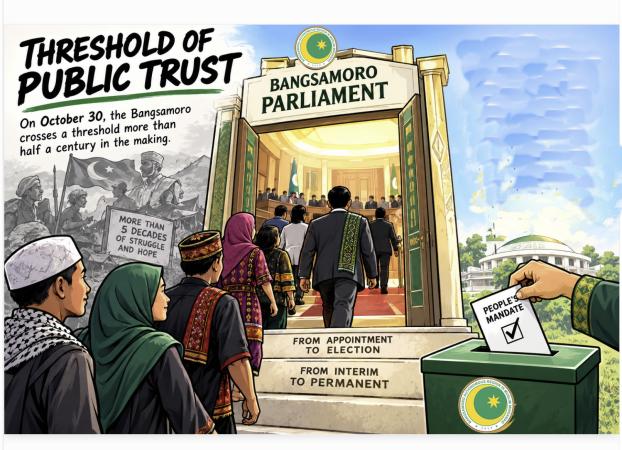
Threshold of public trust
On October 30, the Bangsamoro crosses a threshold more than half a century in the making. For the first time, the Bangsamoro Parliament will convene with members chosen by the ballot rather than by appointment. The interim period, with all its improvisations and compromises, comes to a close. Direct accountability begins.
For the generations who carried the struggle — from the battlefield to the negotiating table, through the signing of the Comprehensive Agreement on the Bangsamoro and the ratification of the Bangsamoro Organic Law — this is no ceremonial milestone. It is the point at which self-determination must prove itself in the daily lives of ordinary people.
Elections divide by design. Campaigns strain alliances, sharpen rivalries and set parties against one another. That is the nature of democratic contest, and the Bangsamoro need not apologize for it. But the measure of leadership is how quickly contest gives way to governance. When the 80 members of Parliament elect the Chief Minister, they will choose more than a head of government. They will show whether the institution places its own integrity above the advantage of any faction.
The work ahead is heavy. Communities across the region are waiting to see whether autonomy will reach them equally: the plains of Maguindanao del Norte and Maguindanao del Sur; the lakeshore towns of Lanao del Sur; the islands of Basilan and Tawi-Tawi; the cities of Cotabato, Marawi and Lamitan; and the young municipalities of the Special Geographic Area.
Autonomy will not be judged by the number of laws passed or the size of the block grant. It will be judged at the rural health unit, in the classroom, in the marketplace and at the municipal hall. Those are the places where people decide, every day, whether their government deserves their trust.
Nor can the new Parliament treat the peace agreement as a closed chapter. The Comprehensive Agreement on the Bangsamoro was signed by the Government of the Philippines and the Moro Islamic Liberation Front, and the two parties remain bound by it. The normalization track, the transformation of former combatants and their communities, and the national government's remaining commitments are unfinished. The elected Parliament is not a party to that agreement, but it is one of its fruits. It must do its part within the powers of autonomy and lend the weight of a popular mandate to the call for the agreement's full implementation.
Moral Governance has long been the compass of the Bangsamoro transition. It now faces its most rigorous test: practice under the full scrutiny of voters. An elected government carries a double duty. It must honor the sacrifices that made autonomy possible, and it must show that self-rule delivers what decades of distant, centralized administration did not.
The campaign banners are down. The speeches are over. What remains is the patient work of building a Bangsamoro that is peaceful, just and united. The people have given their mandate. Those who received it must now earn it, every day of their term.