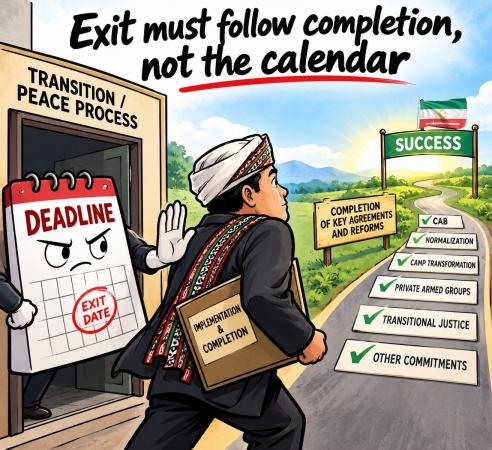
Exit must follow completion, not the calendar
The question of when the Government of the Philippines (GPH) and the Moro Islamic Liberation Front (MILF) will sign the Exit Agreement is being asked more often now. It is a fair question. But the answer is already written, and neither party can rewrite it on its own.
The Framework Agreement on the Bangsamoro (FAB), signed in 2012, sets the terms in Part VII, on Transition and Implementation. At the end of the transition period, the GPH and MILF peace panels, together with the Malaysian facilitator and the Third Party Monitoring Team (TPMT), are to convene to review, assess and evaluate the implementation of all agreements. Only then does paragraph 12 allow an Exit Document officially terminating the negotiations to be "crafted and signed by both Parties if and only when all agreements have been fully implemented."
The words "if and only when" are not decoration. They make the exit a matter of substance, not of dates. The Exit Agreement is not a reward for time served. It is the formal acknowledgment that every commitment under the FAB and the Comprehensive Agreement on the Bangsamoro (CAB) has been delivered.
By that measure, the work is unfinished.
The political track has moved forward. The Bangsamoro held its first regular parliamentary election on September 14, 2026, and the elected Parliament assumes office on October 30. After seven years under the Bangsamoro Transition Authority, the region will be governed by representatives chosen by its own people. The Bangsamoro paid for that achievement over decades, and it should be recognized as such.
The assumption of the elected Parliament marks the end of the transition period, and with it the point at which the FAB calls for the parties to meet and review. The end of the transition opens the review. It does not close the negotiations. Paragraph 13 of the same section is explicit: the panels of both parties shall continue negotiating until all issues are resolved and all agreements are implemented.
The CAB was never a single-track agreement. Normalization was meant to move in step with the political transition, and it has not. Decommissioning of the remaining MILF forces and weapons is incomplete. The socioeconomic package for decommissioned combatants remains short of what was promised. The transformation of the six acknowledged MILF camps into peaceful and productive communities is still underway. Private armed groups have not been disbanded. Transitional justice, which the FAB itself commits the parties to work out, remains largely on paper.
These are not side issues. In 2025, the MILF deferred the final phase of decommissioning, citing delays in the promised socioeconomic support. That decision was a reminder that normalization rests on reciprocity. Combatants who lay down their arms were promised livelihoods. Communities that hosted the struggle were promised rehabilitation and development. An exit signed before those promises are kept would close the negotiating table while leaving the obligations open, with no mechanism left to enforce them.
Who, then, decides the timing? The FAB states plainly that the agreement shall not be implemented unilaterally, and the exit is no exception. In practice, the GPH and MILF Peace Implementing Panels, which succeeded the negotiating panels after the signing of the CAB, recommend the timing. Their principals authorize the signature: President Ferdinand R. Marcos Jr. for the government, and MILF Chairman Al Haj Murad Ebrahim and the MILF Central Committee for the Front. Malaysia and the TPMT sit in the review and lend it their assessment and their credibility. They do not sign the Exit Document.
The September 25 meeting of the panels in Kuala Lumpur restarted the partnership and tasked a technical working group to draft a roadmap for the remaining commitments. That is the right order of things. A roadmap must come before an exit, and a credible one must name what remains, who is responsible, and by when. The meeting did not set an exit date, and it should not have.
Ten Bangsamoro civil society organizations have proposed December 23, 2026 as a deadline, marking the 50th anniversary of the Tripoli Agreement. Their appeal to President Marcos and Chairman Murad reflects a legitimate impatience shared by many in the Bangsamoro, who have waited long enough for the dividends of peace. The call is useful pressure on both parties to move faster. But it is an appeal, not an agreed milestone, and a symbolic date cannot replace the condition the parties themselves wrote into the agreement.
The Bangsamoro does not need an exit that looks complete. It needs a peace that is complete. The GPH–MILF partnership will be measured by whether the remaining commitments are delivered in full, not by how soon a document is signed.
Under Part VII, paragraph 12, of the FAB, the Exit Document may be signed only when all agreements have been fully implemented. As of this writing, the parties have set no date.