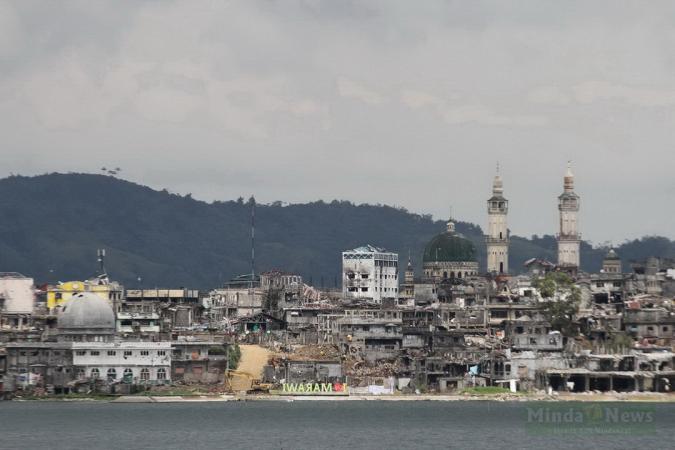
Photo courtesy of MindNews
Moro group seeks Marawi truth commission, faster payouts
COTABATO CITY – Nine years after the government declared the city "liberated," a Moro civil society group on Saturday called for an Independent Truth Commission to look into pre-siege intelligence failures and the executive decisions that led to the destruction of the Islamic City of Marawi, as thousands of its displaced residents remain in temporary shelters.
The Moro Consensus Group, in a statement, said the commission should be composed of human rights advocates, Moro leaders, and civil society representatives.
"There is no genuine liberation while our people remain exiled in temporary shelters, our properties lie in ruins, and the truth behind our city's destruction remains buried," the group said.
While the anniversary is marked by official ceremonies, the group said displaced Maranaos do not regard it as a day of triumph but as "a stark annual reminder of unresolved injustice, state neglect, and unfulfilled promises."
The group traced the 2017 siege by the ISIS-aligned Maute Group to what it called a "failure of intelligence and defense preparation," noting that "it is a matter of record that the national security sector and then-President Rodrigo Duterte had advance information regarding the buildup and presence of ISIS-affiliated militants in Lanao del Sur."
"Why did state security forces fail to prepare adequate defensive measures to protect Marawi City and its residents? How were hundreds of armed militants able to enter, occupy, and stockpile weapons in the heart of the city despite heightened intelligence monitoring?" the group asked.
It faulted the "indiscriminate approach" of the military campaign, referring to the use of aerial bombardment and heavy artillery, for the loss of cultural heritage sites, ancestral homes, and the city's commercial hub.
"The Independent Truth Commission must hold accountable those whose doctrine of engagement reduced a historic Islamic city to ground zero, inflicting losses far beyond necessary tactical engagement," the statement said.
The group also urged the government to fast-track compensation payouts by the Marawi Compensation Board (MCB) before the board's mandate ends in 2028.
It said thousands of legitimate claims have been filed but remain unacted upon because "the current pace of processing and payout remains agonizingly slow," adding that "thousands of affected families have yet to receive a single peso of their awarded compensation."
It called for additional budget, simplified administrative requirements, and more technical staff for the MCB, stressing that no claimant should be left unpaid when the board's term expires.
The group further demanded the dismantling of temporary shelters and the unconditional return of displaced families to their properties in the Most Affected Area (MAA), the part of the city that sustained the heaviest damage.
"Living in temporary shelters was meant to be a transient measure, not a permanent sentence. The slow pace of basic utility installation, land title re-mapping, and bureaucratic hurdles in the MAA have effectively barred indigenous residents from exercising their fundamental right to a dignified, safe, and unconditional return to their ancestral land," it said.
"The destruction of Marawi destroyed the economic backbone of the Maranao community. Continuing to keep families in transitory sites perpetuates generational poverty, dependence on relief, and social disenfranchisement," it added.
On the same day, the military and the local governments of Marawi City and Lanao del Sur held a wreath-laying ceremony at Kampo Ranao, headquarters of the Philippine Army's 103rd Infantry "Haribon" Brigade.
The rites were led by Secretary Nasser Pangadaman Jr., Presidential Adviser for Marawi Rehabilitation and Development, and Brig. Gen. William George S. Cordova, Assistant Division Commander of the 1st Infantry "Tabak" Division. Brig. Gen. Jessie R. Montoya, 103rd Infantry Brigade commander, vowed that the siege "will never happen again."
The five-month conflict, which began on May 23, 2017, left 168 government troops, around 900 militants, and an estimated 50 to 90 civilians dead.